
Election 2026: If the ballot offers no choice, say so
The central constitutional question for Shetland is not on the ballot paper. The people of Shetland are not being offered the range of options that were once explicitly identified for them.
If the system now offers only candidates who all operate within the same closed framework, voters are entitled to register that fact clearly and peacefully.
Why protest on the ballot paper?
The Shetland Report identified a range of constitutional possibilities for Shetland, from the status quo to independence. Yet in practice, voters are now presented only with candidates operating within the status quo.
If that is so, the ballot itself becomes one of the few remaining lawful ways to say: this is not a real choice.
Where the system has been closed around one permitted outcome, a clear ballot-paper protest is a legitimate form of public dissent.
What to do
- Take your ballot paper as normal. Bring a marker pen.
- Do not place a cross for any candidate if none represents the constitutional choice you seek.
- Write “NONE” clearly and boldly across the paper.
- This should be plainly visible as a deliberate protest, not an accidental spoiled ballot.
This is not a vote for a candidate. It is a visible statement that the available options do not meet the constitutional question before Shetland.
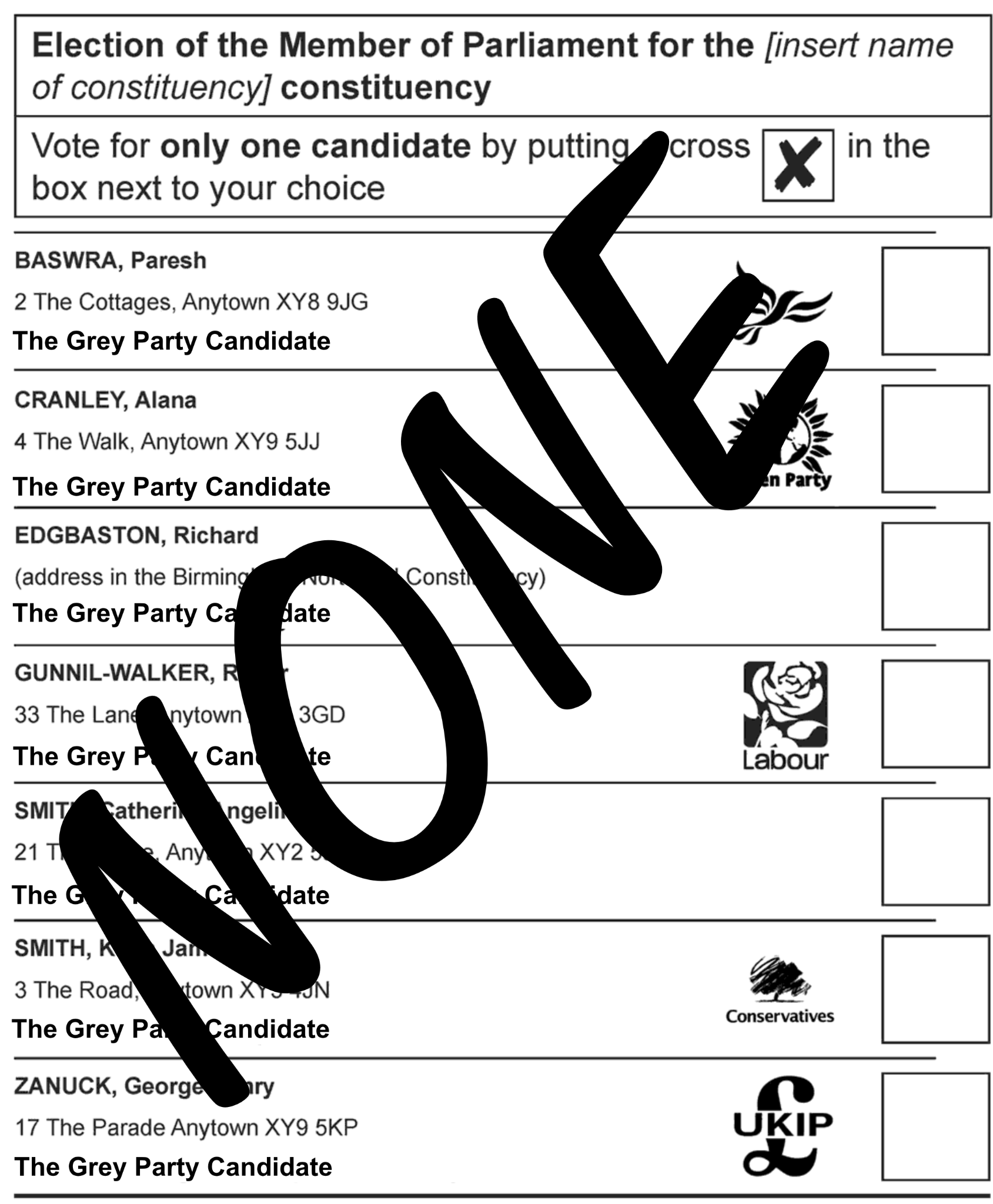
Example. The aim is clarity: a deliberate and unmistakable protest where no meaningful constitutional option is offered on the ballot.
Deliberately spoiled ballot papers are counted.
The point being made
This is not disruption. It is a lawful and peaceful means of recording dissatisfaction with the narrow terms in which the electorate is being asked to choose.
A rejected ballot is still evidence. It shows that some voters did not consent to the closed terms of the choice presented to them.
If there were a proper “None of the above” box on the ballot paper, that would be better. In its absence, voters may make the point directly themselves.